
Turning concepts into action.
This work is where it all started.
Medical illustration and firsthand patient care taught me how to break down complex science, understand clinical workflows, and translate technical ideas into something people could actually use and trust. It sharpened my ability to ask the right questions early: about use cases, users, and real-world impact.
Today, my work doesn’t always end in a visual deliverable. But the same systems thinking, clarity-building, and storytelling now drive healthcare strategy, workflow design, and innovation programs that lead to real adoption.
The medium changed, but the goal is the same: making great ideas real.

Animation by MeCo Visuals for Team IUT at Dell Medical School at the University of Texas. Visual explanation of the proposed solution, developed by Team IUT, to prevent Intrauterine device expulsion when implanted in an immediately postpartum uterus.
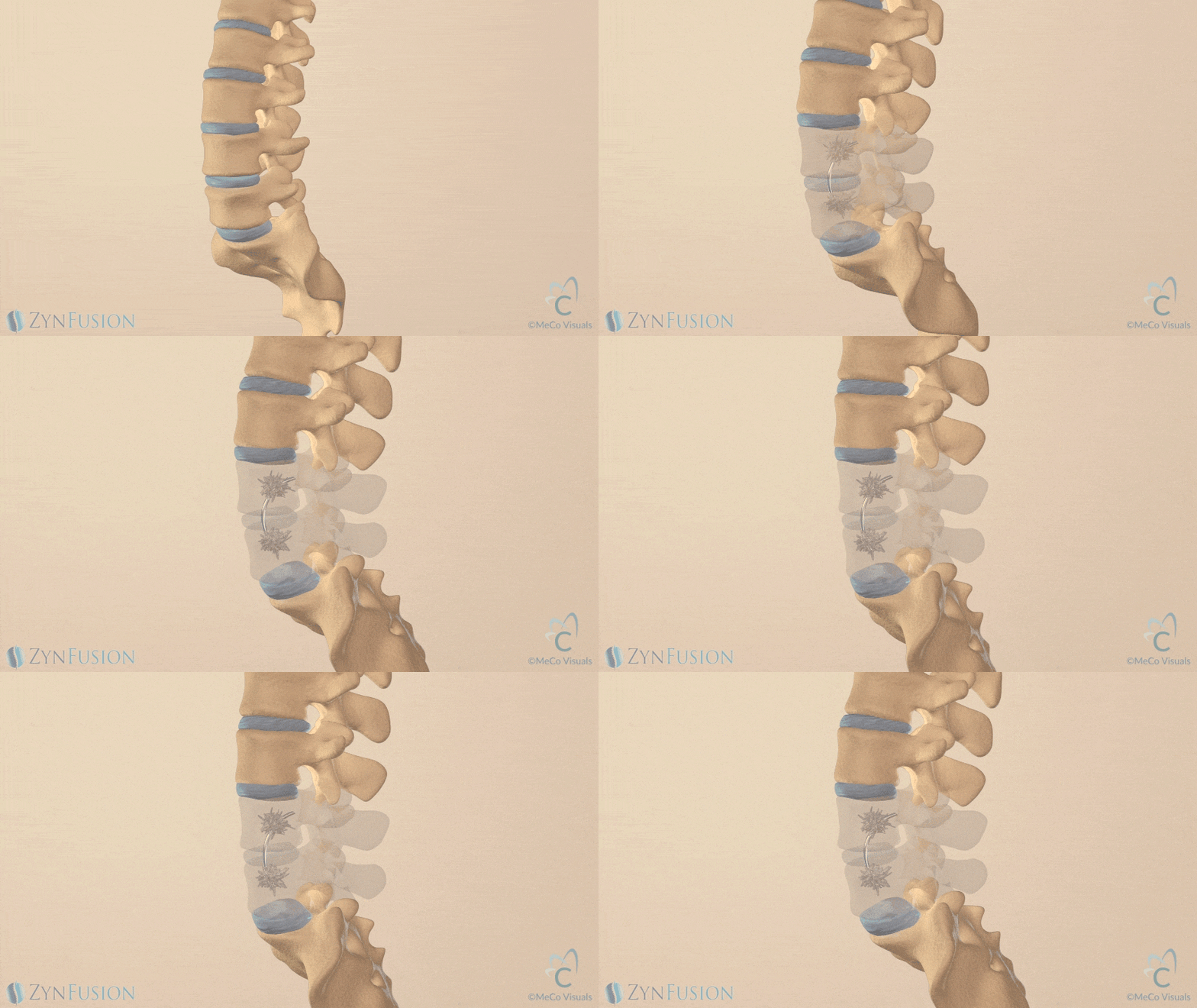
This animation was created for a Texas-based medical device company to visually explain the mechanism behind their recently patented spinal fusion device. Components are built from a Nitinol alloy that bends at body temperature, offering seamless delivery. An internally-loaded balloon system inflates a caged anchor, which then remains within the patient. Cement flows through the system, followed by the addition of an internal flexible rod. Unlike most spinal fusion hardware, the minimally-invasive mechanism highlighted here depicts a flexible device: this results in a greater range of motion and shortened recovery time for the postoperative patient.

This 3D rendering of the virus that causes COVID-19 is based on AMI Members' combined efforts and structures from the Protein Data Bank. The image includes numerous M surface protein dimers courtesy of the Feig lab, a few E pores (PDB 5X29), and several large glycosylated trimer S spikes courtesy of Rommie Amaro at the UCSD Amaro Lab. This image was featured on the Medical Illustration and Animation Sourcebook Cover